Competitive intelligence
Reads the signals inside released games and turns them into clear views of product direction, design choices, monetization, and technical strategy.
Game competitive intelligence
HeyCici helps game teams look inside shipped products—not to copy them, but to understand the decisions, systems, and patterns that made them work.
✓Running as a real production platform
✓Turns product evidence into clear competitive briefs
✓Provides the foundation behind AI-assisted game reconstruction
Why HeyCici exists
Downloads and revenue only describe the surface. The useful questions live deeper: what changed between releases, how a game earns money, how its levels evolve, which systems are reused, and where the team placed its engineering effort. HeyCici was built to turn those questions into evidence a game team can actually use.
One product, three connected systems
Reads the signals inside released games and turns them into clear views of product direction, design choices, monetization, and technical strategy.
Uses grounded project evidence to help rebuild understandable game systems and shorten the distance from research to a working prototype.
Keeps evidence, relationships, reports, and workflows in one operational product so each new analysis makes the next one stronger.
How the system works
A game build enters the pipeline together with its version identity. The system supports the evidence available from common Unity and Cocos release formats without requiring the original source project.
Code structures, calls, configurations, assets, levels and technical fingerprints are processed into a consistent model instead of remaining as disconnected files.
Deterministic services handle facts such as SDK signatures and version relationships. AI is used for synthesis—reading the evidence, connecting patterns and producing briefs with traceable support.
Results become searchable intelligence, reports, APIs, dashboards and inputs for the AI Re-coder, allowing product, design and engineering teams to work from the same evidence layer.
What we have already made possible
HeyCici can compare releases and reveal where a team changed direction—whether that shift happened in gameplay, difficulty, monetization, or live operations.
It can surface the advertising, analytics, payment, offers, and progression choices embedded in the game, then translate them into language product teams understand.
Shared frameworks and recurring patterns become a kind of technical DNA, showing how studios reuse foundations and where they invest in control or speed.
Instead of leaving extracted data as raw files, HeyCici connects it back to the player experience so designers can study structure, content, and intent.
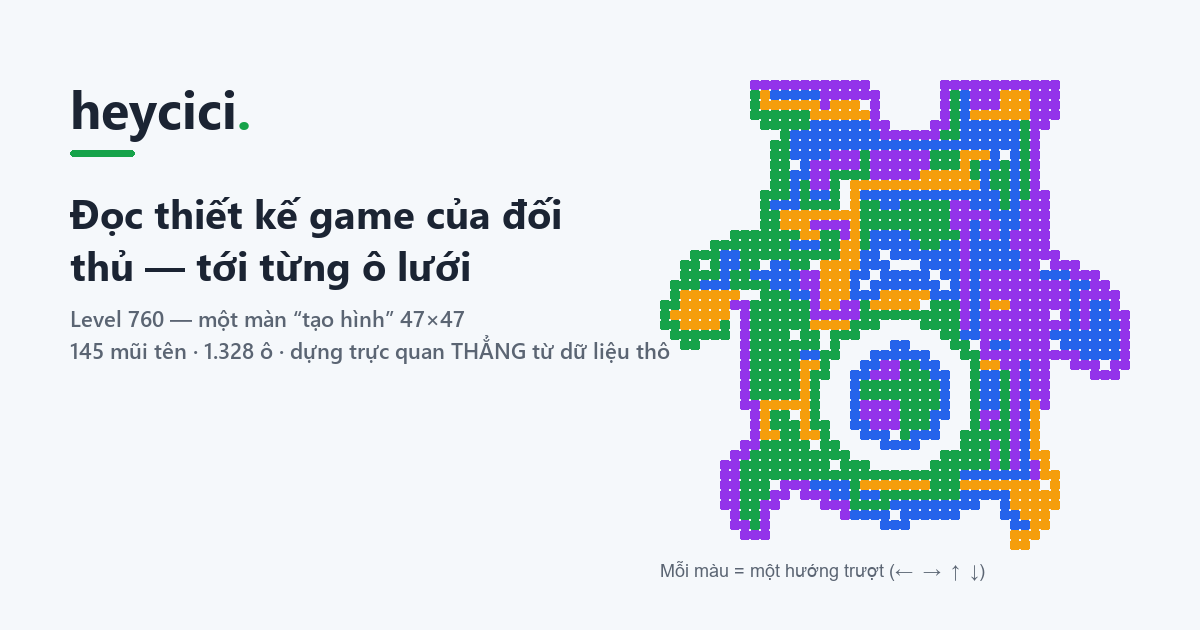
A real report example
This public research note shows the kind of deliverable HeyCici can produce: a readable argument supported by evidence recovered from shipped games—from level structure and monetization to SDK usage and architectural patterns.
Selected verified evidence
The following figures come from selected production analyses. Game and studio names are intentionally withheld for a public portfolio.
A complete progression revealed how difficulty was distributed and how board complexity changed over time. A version comparison also exposed a major rewrite in core board-generation behavior.
Bundles, currencies, boosters, remove-ads offers and seasonal products could be read as an actual monetization catalog—not inferred from screenshots or market estimates.
A released product exposed the structure of a reusable casual-game framework spanning live operations, levels, boosters, payments, player state and offers. The result is readable and compilable; behavioral equivalence remains a separate validation problem.
Images, prefabs, animations, shaders, audio and configuration objects were indexed and connected. Image fingerprints make art changes and reuse measurable across releases.
Grid coordinates, directions, rewards and content structure were recovered deeply enough to recreate the visual intent of levels and analyze a full content library instead of isolated screenshots.
Shared namespaces, framework patterns and asset fingerprints reveal which products inherit the same foundations, where code was forked, and how studios trade speed for control.
Who this changes work for
Study real difficulty curves, progression, economies and level structures before committing months to a hypothesis.
Learn from frameworks and architectural patterns that already survived production, while seeing their trade-offs rather than copying blindly.
Connect monetization, SDK usage, offers and release changes to a clearer picture of how a product is operated.
Compare asset libraries and visual changes across versions with evidence instead of manual cataloguing.
Product architecture
HeyCici separates extraction, evidence storage, intelligence and delivery so each layer can evolve independently. New games enrich the corpus; shared frameworks and recurring patterns make later analyses faster and more useful.
Version-aware pipelines coordinate unpacking, static analysis, asset processing and large batch workloads.
Structured records, object storage, relationships and searchable context preserve the chain from a conclusion back to its source.
Deterministic detectors, comparison services and grounded AI analysis turn raw evidence into product knowledge.
Dashboards, CMS, reports, integrations and AI tool interfaces expose the same intelligence to different teams.
How we use AI
HeyCici is designed around evidence. When a result can be determined by rules, we use rules. When AI interprets the evidence, the conclusion stays connected to its source. If the system cannot support a claim, it should say so. The goal is not an impressive answer—it is a trustworthy one.
I designed and built HeyCici end to end—from product direction and system architecture to analysis pipelines, backend services, AI workflows, deployment, and production operation.heycici.
The foundation is running, the product is learning from real game evidence, and the next step is turning that depth into a tool more teams can use.